What to Expect in Your First 30 Days with a New Smile
Choosing full-arch dental implants is a big decision. You are not just fixing teeth; you are giving yourself a fresh start with eating, speaking, and smiling. Those first 30 days can feel a little unknown, especially if you have been dealing with loose dentures or missing teeth for a long time.
We want you to know this: the first month is not a test you have to pass alone. It is a guided healing process, and patient care comes first. You are in good hands, and every question you have is welcome.
During these first weeks, it is very normal to feel a mix of emotions. Many people feel relief and excitement, but also some worry about pain, what they will be able to eat, or how their speech will sound. That is all okay. Our goal is to make this time feel calm, clear, and as comfortable as possible.
In this guide we will walk through what life usually looks like in the first 30 days with full-arch dental implants: your diet, your speech, your healing milestones, and clear signs of when to call your dentist. Our hope is simple: to help you smile with confidence and feel supported every step of the way.
Your First Week After Full-Arch Dental Implants
The first few days after surgery are mostly about rest and gentle care. Some swelling, tenderness, and even light bruising near your cheeks or jaw are common. This is your body doing its repair work.
To stay more comfortable, we usually suggest:
- Resting with your head slightly raised on extra pillows
- Using cold compresses on the outside of your face as instructed
- Avoiding heavy lifting or bending over too much
- Taking it slow with talking and daily tasks
Our planning and technology help make this phase more predictable, but you should still listen closely to your body. If you feel tired, rest. Healing is your main job right now.
Pain control is a big concern for many people. We guide you on the best timing and dose of any recommended or prescribed medications. Staying ahead of discomfort is easier than waiting for pain to build up. Follow the instructions you receive from our team instead of comparing your experience with stories online. Everyone's body is different, especially between ages 40 and 70.
If your pain feels sharper, stronger, or very different from what you were told to expect, that deserves a call. There is no judgment, only solutions. We would much rather talk with you early than have you tough it out in silence.
Good oral care starts right away, but gently. For the first days:
- Do not brush directly on the surgical sites
- Avoid strong swishing or spitting
- Use any recommended rinses as directed
- Keep the rest of your mouth as clean as you comfortably can
You will go home with clear written instructions so you do not have to remember every detail. Keeping your mouth clean helps your implants heal and supports long-term comfort and function.
Eating with Confidence: Your 30-Day Healing Diet
What you eat in the first month is like the support crew for your new smile. Even though full-arch dental implants are made to be strong, the bone and gums around them are still getting used to the change. Gentle, soft, and nourishing foods protect that healing area.
Think of this as a short "soft food season" that protects your investment and helps you enjoy better eating for years to come.
Here is a simple week-by-week guide many patients follow:
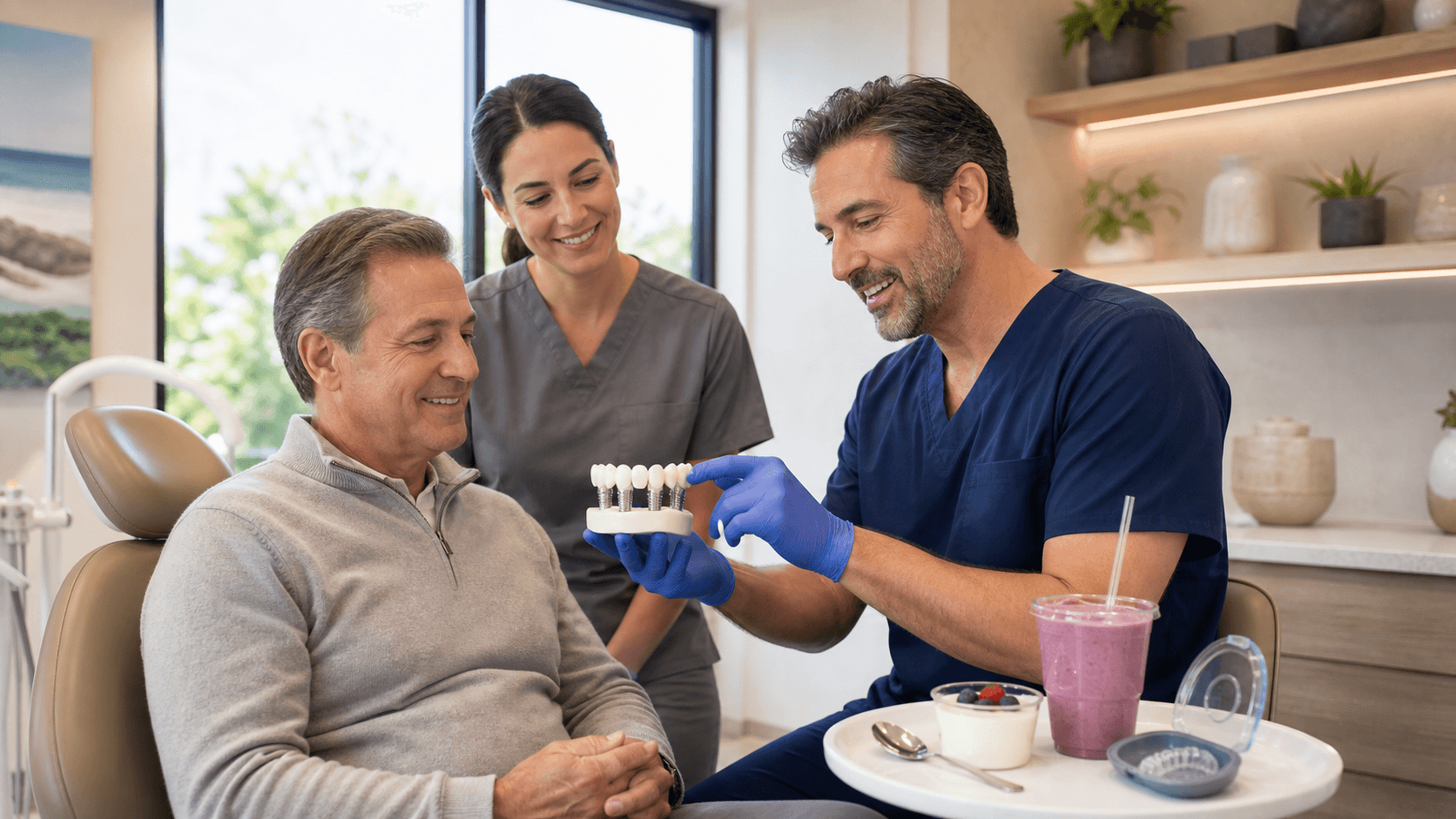
- Week 1: Liquids and smooth, soft foods. Good choices are broths, yogurt, smoothies (not with seeds), mashed potatoes, blended soups, and pudding. Skip very hot, crunchy, or chewy foods, and avoid straws unless we tell you they are okay.
- Week 2: Still soft, but a bit more texture. You might add scrambled eggs, soft pasta, cottage cheese, oatmeal, and very well-cooked vegetables that are easy to mash with a fork.
- Weeks 3, 4: Slowly add more variety. Soft fish, soft rice, and tender cooked vegetables usually work well. Still avoid hard, sticky, or tough foods like nuts, hard bread, chewy meats, or candy.
If something does not feel quite right when you chew, it is fine to slow down and go back to softer foods for a few days. There is no prize for rushing.
Warm weather can make soft foods easier and more pleasant. Many people enjoy:
- Chilled yogurt parfaits with soft fruit pieces
- Ripe bananas or peeled ripe peaches cut into small bites
- Smooth hummus with very soft, steamed vegetables
- Baked or poached fish such as salmon, flaked into tiny pieces
- Light, blended vegetable soups that are served lukewarm
You are not stuck eating like this forever. This is just a bridge from surgery to a more confident, flexible diet with your full-arch dental implants.
Adjusting Your Speech and Everyday Comfort
Full-arch dental implants change the shape and feel of your mouth. It is completely normal if your speech sounds "different" to you at first. Your tongue, lips, and cheeks are learning new positions around your new teeth.
Most people adjust within a few days to a few weeks. Simple practice helps:
- Read out loud for a few minutes a day
- Talk on the phone where you feel less watched
- Slow down your speech and focus on clear sounds
Sounds like "s," "sh," and "th" can feel tricky. Try saying simple phrases in a quiet room where you do not feel rushed or judged. As you feel more steady, start shorter conversations in social settings and build up from there.
Often, you will notice every tiny change in your own voice while friends and family are only noticing that you are smiling more. Many people find that once they relax, their speech improves even faster.
There is also an emotional side to this. If you have spent years hiding your smile, seeing a full set of teeth in the mirror can be surprisingly moving. Some people feel a wave of relief; others feel a little shy at first. All of those feelings are normal. Our role as your trusted dental home is to support both your mouth and your confidence as this new smile becomes your new normal.
Healing Milestones and When to Call Your Dentist
In the first 30 days, you will likely notice:
- Swelling at its peak in the first few days, then slowly going down
- Tenderness that eases week by week
- Eating soft foods becoming more comfortable by weeks 3 and 4
- Your new teeth starting to feel more like part of you
Your gums and bone will keep adapting for many months, but this first month lays the groundwork. Healing speed is personal, especially for adults in midlife and beyond. We shape your follow-up plan around your health, your surgery, and how your body responds.
Some signs mean it is time to call the office:
- Sudden increase in pain after things had been improving
- Heavy or long-lasting bleeding that does not match your instructions
- A strong bad taste or odor that does not get better with gentle cleaning
- Any looseness or movement in your new teeth or implant bridge
- Fever, chills, or feeling generally unwell
Reaching out early is always better. You are never "bothering" us. We make it easy to ask questions, because early help often means easier care and smoother healing.
Follow-up visits in the first month are not just checklists. They are a chance to fine-tune your bite, check your healing, adjust your care routine, and answer new questions. Our technology helps us see how your implants and bone are coming together so we can support strong, lasting results. Over time, these visits feel less like appointments and more like check-ins with a team that knows your story and wants you to feel at home every time you smile.
Reclaim Confident Smiles With Long-Lasting Implant Solutions
If you are ready to restore your smile, our team at Ridgetop Dental Implants is here to guide you through every step of the full-arch dental implants process. We will evaluate your needs, explain your options clearly, and design a personalized treatment plan that fits your goals. Schedule a consultation today by using our contact page form so we can help you get back to comfortable chewing and confident smiling.